I want to share this thought-provoking video posted recently by Paul Stamatiou. It's from Professor Michael Wesch from Kansas State University, and is called "A Vision of Students Today". I'd like to say that a lot of the points this video brings to the table are very true, while some are questionable. I'll post the video first, and then say what I think. If you're going to read the rest of the entry, please watch the short video first. Otherwise you'll just ruin it, and this is worth looking at.
First of all, the whole "boo hoo I only get 7 hours of sleep a night" is completely ludicrous. Seven hours of sleep for me and everyone I know is a very good night. In reality, most students hit the hay somewhere between 2 and 3am, and start the day somewhere between 7 and 8. Also, in the point about being $20 000 in debt post-graduation, it's very important to note the following point, which was, "I'm one of the lucky ones". That is to say, you'd be lucky to finish owing only that much. Most people will be stuck with quite a bit more.
Most importantly, the attention they bring to to abusing laptops in the classroom seems to point a blaming finger at the technology itself. There's no doubt that there are lots of people Facebooking in class or doing other unrelated things. (On some campuses I know it's common to see people playing WoW in class.) But there's an equal number of people, at least in my classes, who are earnestly taking notes, following along with PDFs, using Wikipedia to quickly look up an unfamiliar term, etc. I use my laptop for all of these things in class on a daily basis, in addition to keeping my schedule straight and up to date using applications like iCal. I wish more people at Guelph were savvy enough to use Google docs to create collaborative notes like we saw at the start of that movie. Maybe I should get on my high horse and encourage this.
The point is, you're the one to blame if you don't have the self-discipline to pay attention and take notes instead of throwing a sheep at somebody on Facebook. I've made a concerted effort this year in a bunch of my classes to sit closer to the front, where the hard workers are most prominent and distractions from chattering bozos are at a minimum. And yes, you might end up sitting next to that annoying guy who puts his hand up in lecture every week to share an anecdote about his cat which he thinks is somehow relevant, but hey, it's not like you're going to (most) lectures to make friends.
One more comment - on the multitasking point - how true it is. While perusing the WoW forums the other day, I read an amusing story about a Hunter, (big surprise there!) that made their group wipe during a menial dungeon encounter. (For the uninitiated, that means the group all "died" and lost real time and game money.) Their reason? "Sorry guys, I'm trying to do a little studying for my exam in the morning and I stopped paying attention for a moment." Classic.
Now I want to segue to something else. In that video, we saw a fair number of Macs, which, culturally speaking, is a noteworthy part of the "vision of students today". I think it's a fair assessment that probably about a third of the laptops I see around campus nowadays are MacBooks, (or MBPs). To tell the truth, I'm a little irked that they're gaining popularity so quickly. And I can't honestly say if that's more because of the materialistic desire to stand out, or the sense of deflowered elitism I get when I meet more and more new Mac converts who don't know who "the Woz" is, but are happy to be looking hip. Windows Vista is the new Paris Hilton - the thing everyone loves to hate. And, honestly, I don't think there's that much to hate about it. Yet even if there is, it bothers me when people are all over the Hate-Vista-Love-Mac bandwagon but can't tell you a thing about either one of them, aside from "Macs are just so cool."
Am I far too elitist for my own good? Probably.
The other, more legitimate reason to be concerned with Mac Mania is the realization that the popularization of Macs will compromise the sweet, easy, Norton-less world we've come to know and love. By the way, it's not just me giving my unprofessional opinion - I'm getting this straight from Tech otaku Leo Lapporte's mouth. It's not as if Apple products have strong-like-bull security features built in. (Just look at Apple TV and the iPhone.) The reason Macs don't have virus problems is because - who uses a Mac? Yeah, nobody. Oh wait, no. Scratch that. It's all changing now. If everyone and their mother starts running OS X, you can be sure people will start writing viruses and other malware for it, and the next thing I know I'll have some abomination of software called iNorton going, "IM IN UR MENU BAR, HOGGIN UR RESOURCES"
Oh, and congratulations to Kat on her new MacBook. I won't pretend I'm not jealous of its Core 2 Duo-ness and the fact that she's running Leopard, but goodness knows she's probably the most deserving new Mac convert I know. May the Force be with you, may the RAM behoove you. Namaste!
Acquisition of Facebook Good for Upstart Networks?
So, as I said, the midterm season's kept me extremely busy, and now that that's over I've got a fair bit of catching up to do with reading, assignments, and so on. But probably the biggest news of the day (or the week) is Microsoft's deal with Facebook to purchase 1.6 percent of the company for 240 milllion dollars, which gives Facebook as a whole a valuation of like 15 billion. Whoah. For those of you who are unaware or forgot, this is the same Facebook that was invented by Harvard undergrad Mark Zuckerberg, in his dorm room, when he was my age. That's pretty good.
But hold the phone, sister. This article from the Associated Press hints that this whole arrangement could spell trouble for the social networking site down the road. If Facebook becomes too burdened with advertising, social networking addicts, (ie. every 14 to 23 year-old North American), may begin seeking more open alternatives such as the likes of Ning. This kind of jump doesn't seem unreasonable at this point either, especially now that Facebookers are used to higher levels of of customization thanks to the Applications platform. One way or another, what goes up must come down. Just like ol' Faceberg probably stayed down the day after this kegger at Facebook HQ celebrating the $15 billion valuation. Yeah, that's him doing the kegstand. (Photo courtesy of FSJ.)
Random: That new Radiohead album is fantabulous! My favourite In Rainbows track, currently, is "House of Cards". If you haven't checked this album out yet, do it. It's good for you.
This is a post I've had rolling around in my head for several weeks now, and while it may be a little behind the times I'm going to get it out of my system anyway.
On May 24th of this year, the social network sensation Facebook introduced the ability to create applications for use on on the site. They range from useful things like a feed to del.icio.us links, to pointless, fun things like gifts, plants, pets, and one of my favourites, The Honesty Box. ("What do you really think of me? Answers are completely anonymous!")
At first these things seemed like a fun way to jazz up the uniform Facebook UI and give each profile its own unique look, as well as provide a way, if you're a developer, to share your creativity with your friends. That's all fine and good, until the sheer amount of clutter starts to overwhelm the core features of the site.
I've seen quite a few complaints about "application invite/request spam". A good example, large screenshot included, is a recent post from Paul S's blog. It clearly demonstrates how out of hand things can get when you have a lot of friends enthusiastically using and sharing their favourite applications. Personally, I don't have this problem - I guess because a lot of my closest friends are of the same mind as me, and maybe partly because I've never replied or sent requests to anyone else.
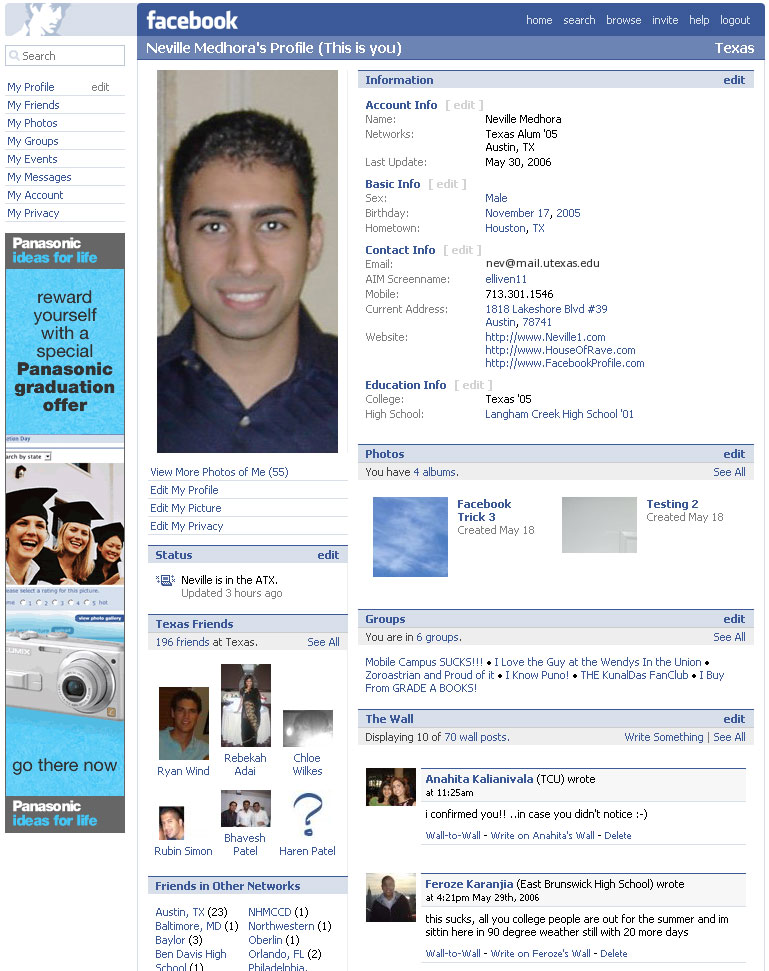
While I'm sure application spam is a legitimate concern for a lot of people, my main beef comes from a design perspective. (Not that I have any sort of qualification, other than being a 12-year-or-so veteran of internet browsing.) To put it simply, a lot of people's Facebook profiles are ugly now. Myspace-ugly. The reason a lot of college/university students embraced Facebook in the beginning was because it was a welcome change from the loud, obnoxious Myspace pages with background music and colour schemes that look like my sister's bedroom in the early 90's. Let's compare, shall we? Here's what profile pages looked like back in the day; ie. when I joined about 14 months ago: By the way, I don't know this guy. The image is from Google. But it demonstrates how nice and clean things used to be. Nowadays you're more likely to see something like this:
It's not that I have some grudge against colours. This particular example isn't really too bad. (Again, from Google.) None of the apps pictured here are stupid or pointless, nor do they even look that bad. With this guy we'd be looking at a functionality issue, where the information you're looking for could easily get lost in all the other data that's there.
Here are two beliefs that I hold:
Number One: Mainstream trends are leaning more and more toward sleekness and minimalism. I'm sure we can all agree that Apple has been at the forefront of this revolution. Just look at the iPhone or the iPod Touch to witness the ultimate example of minimalist design in consumer electronics. It's what appeals to people these days. We see the same abstract themes in the design of cars and other material things. This might be a bit of a stretch for some people, but if you think about it, the same or similar elements of design are often present in everything from web browsers to electric shavers. (You may snicker at me for putting so much emphasis on fashion, but I would challenge you to provide a convincing argument that aesthetics aren't an enormous part of secular culture.)
Number Two: Convenience is a hugely important factor in our day to day lives, especially when it comes to computer usage. Well-designed websites make data access as easy as possible, with more information readily available. It's organized and uncluttered. Period.
Facebook is moving away from both these things. It has taken two steps backward in allowing users to transform its look into something reminiscent of the chaotic Myspace era, while simultaneously making it harder to access information. Which leads me to my next point: Facebook also gives users a huge amount of privacy settings, so that they can modify their page in almost any way imaginable to hide or limit certain aspects from the world, or just certain people - like parents. Maybe it's because I'm more willing to police my own content, but I can't identify with people who feel that they need to block access to their profile page from folks they don't have listed as friends. While it's possible that there are some people who only want their friends to know that they like watching The Hills, (understandable) I think the major concern is with items like contact information and Wall posts.
I say, if it's something you'd be worried about somebody knowing, then don't post it at all. If your friend needs your new address, that's what private messages are for. Back in April, the cover story from Wired magazine talked about how transparency is the best policy for business and social interaction these days, and increasingly so in the coming years. I won't spend time going into that, but in a nut shell, just think of it in terms of: "Nothing To Hide = Trust". Make sense? I think so. It's a better idea to not publicly share things in the first place and be prepared to put forward the tiny bit of effort required to moderate content, rather than bluntly hide information and make people wonder.
So, in the end, what we're seeing is Facebook making 3 major mistakes. Still, its popularity is on the rise even now, and I'm sure its success isn't near its end yet. I'm just saying we've seen the beginning of the end. I think Google's on the same page as me, considering that some information's recently leaked about a few web apps they'll be putting out that will challenge Facebook head-on.
Anyhoo. Time will tell. Right now time's telling me it's time to pack up and book it to Zoology.